Collaborative Academic Project Initiated in Mar 2024 and Refined in May 2025 Teammate: Jiaai Shen, Ziqian Liao
1. Introduction
This study investigates the feasibility of utilizing domestic cat vocalizations to classify their emotional states. A significant challenge in pet ownership lies in accurately interpreting the needs and affective conditions of animals, a task that proves particularly complex in feline species due to the high variability in their acoustic expressions. Individual cats may employ distinct vocal signals to convey analogous meanings, introducing ambiguity in human-animal communication. Given the nuanced and often context-dependent nature of feline vocalizations, this research explores the application of artificial intelligence to enhance human understanding of cat emotions, thereby facilitating improved care and welfare.
2. Problem Statement
Can feline emotional states—such as pleasure, anger, or pain—be reliably inferred solely from their vocalizations?
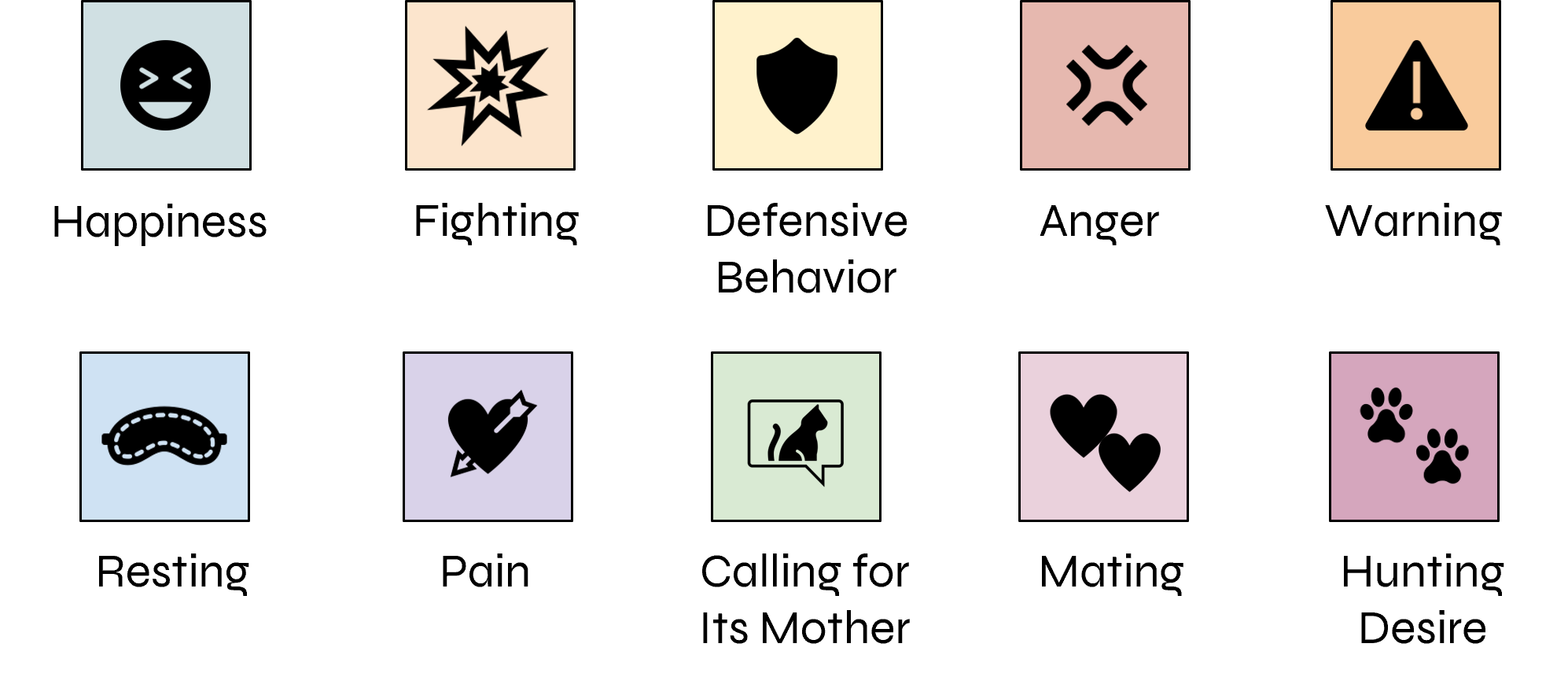
The objective of our study is to develop an artificial intelligence model capable of accurately classifying feline emotions from vocal signals. Given an input audio sample, the model will predict the most probable emotional state, outputting a discrete label (e.g., "Anger," "Happiness," "Resting"). This approach aims to provide a scalable and non-invasive tool to improve human understanding of domestic cat welfare needs.
Why using AI?
AI performs better than human beings in certain classification tasks. It can potentially distinguish the nuances between cats’ vocalizations and help humans understand cats’ affective states and welfare needs.
AI can also help with cats welfare monitoring when humans are absent.
Why using cats’ vocalizations to detect emotions?
Because it's non-invasive!
3. Data